Search

Australia's national climate risk assessment
Acceso al documento
MAP20250016408
Australian Climate Service
Australia's national climate risk assessment / Australian Climate Service. — Canberra : Australian Climate Service, 2025
284 p.
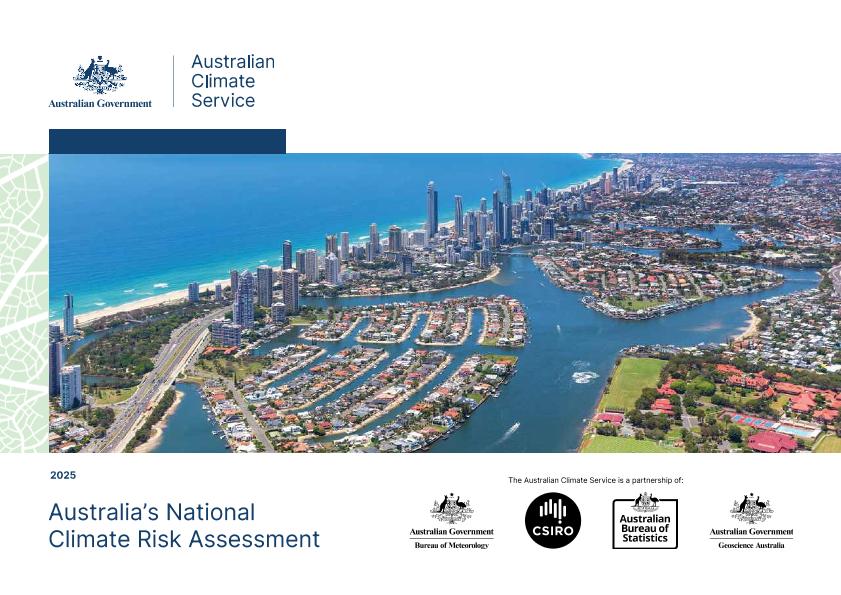
En portada: Australian Government: Bureau of Meteorology, CSIRO, Australian Bureauof Statistics, Australian Government: Geoscience Australia
Documento relacionado: Australian Climate Service. Australia's national climate risk assessment : an overview. - Canberra : Australian Climate Service, 2025
Executive summary -- Introduction -- Key concepts -- Climate risks to Australia -- Aboriginal and Torres Strait Islander Peoples system -- Communities urban, regional and remote system -- Defence and national security system -- Economy, trade and finance system -- Health and social support system -- Infrastructure and the built environment system -- Natural environment system -- Primary industries and food system -- Governance and adaptation -- Acknowledgements and authors -- References -- Appendix: national assessment technical report abstracts. — Sumario: The Australia's National Climate Risk Assessment 2025 provides the country's first comprehensive evaluation of climate-related physical risks, identifying 63 nationally significant threats and analyzing 11 priority risks across eight key systems: communities, economy, infrastructure, health, defence, natural environment, primary industries, and Aboriginal and Torres Strait Islander Peoples. The report highlights that Australia is already experiencing more frequent and severe climate hazardssuch as heatwaves, bushfires, floods, and sea level risewhich are projected to intensify under global warming scenarios of +1.5°C, +2.0°C, and +3.0°C. Coastal communities, regional and remote populations, and Indigenous communities are particularly vulnerable due to infrastructure gaps, socioeconomic disadvantage, and cultural ties to land and water. By 2090, over 3 million people may live in high-risk coastal zones, and critical infrastructure, health systems, and supply chains will face escalating disruptions. The report emphasizes the need for transformational adaptationsuch as managed retreat, resilient infrastructure, inclusive governance, and integration of Indigenous knowledgewhile warning that current adaptation efforts are fragmented and underfunded. It calls for coordinated national planning, improved data, and long-term investment to reduce exposure, build resilience, and safeguard Australia's people, ecosystems, and economy in a rapidly changing climate
1. Clima . 2. Riesgos meteorológicos . 3. Catástrofes naturales . 4. Impacto económico . 5. Medio ambiente . 6. Infraestructuras críticas . 7. Ayuda en siniestros . 8. Cambio climático . 9. Australia . I. Australian Climate Service . II. Title.