

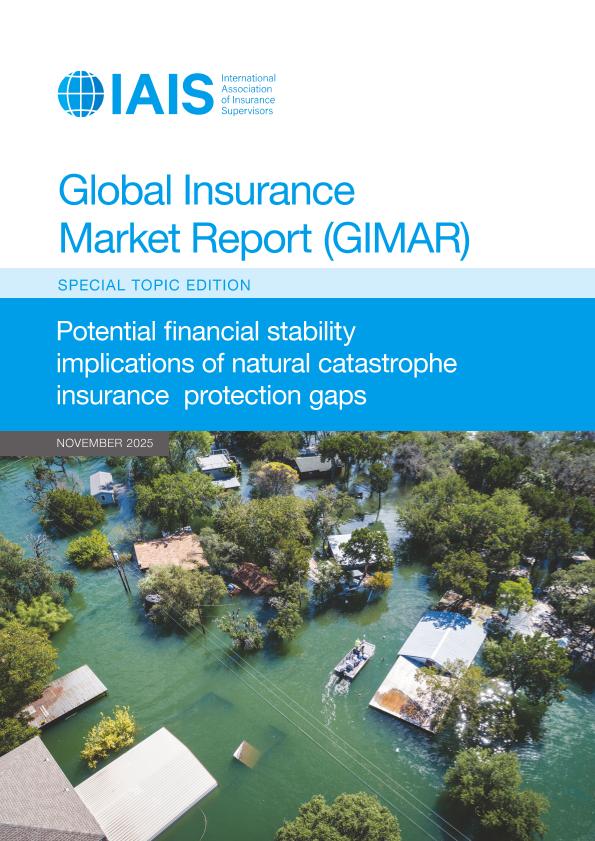
Global insurance market report (GIMAR) : potential financial stability implications of natural catastrophe insurance protection gaps
Contenido multimedia no disponible por derechos de autor o por acceso restringido. Contacte con la institución para más información.
| Tag | 1 | 2 | Valor |
|---|---|---|---|
| LDR | 00000cam a22000004 4500 | ||
| 001 | MAP20250018464 | ||
| 003 | MAP | ||
| 005 | 20251112100712.0 | ||
| 008 | 251111s20251101che|||| ||| ||eng d | ||
| 040 | $aMAP$bspa$dMAP | ||
| 084 | $a328.1 | ||
| 110 | 2 | $0MAPA20080470760$aInternational Association of Insurance Supervisors | |
| 245 | 1 | 0 | $aGlobal insurance market report (GIMAR)$b: potential financial stability implications of natural catastrophe insurance protection gaps$cInternational Association of Insurance Supervisors |
| 260 | $aBasel$bInternational Association of Insurance Supervisors$c2025 | ||
| 505 | 0 | $aAcronyms -- Executive summary -- 1. Introduction -- 1.1 Relation to other IAIS work -- 1.2 Scope of the report -- 1.3 Sources -- 1.4 Structure -- 2. Natural catastrophe insurance protection gaps -- 2.1 Definition of protection gap and its components -- 2.2 Drivers of protection gaps -- 2.3 Insights from IAIS members -- 3. Framework for assessing financial stability risks of NatCat events -- 3.1 Context and key concepts -- 3.2 Impact of NatCat events -- 3.3 Insurance as a mitigant -- 3.4 Amplification effects and broader implications -- 4. Potential financial stability implications of NatCat protection gaps evidence from case studies -- 4.1 Description of the approach to case study analysis -- 4.2 Key insights from the case studies -- 5. Actions to address protection gaps -- 5.1 Data collection and assessment -- 6. Conclusion and next steps -- Annex 1: Detailed descriptions of case studies -- Annex 2: Climate-related financial risk analysis conducted by the World Bank | |
| 520 | $aThe document explores the financial stability risks posed by natural catastrophe (NatCat) insurance protection gaps, emphasizing how uninsured economic losses from disasters like floods, earthquakes, and hurricanes can disrupt economies and financial systems. Through theoretical analysis and six case studies (Malawi, Dominica, Pakistan, New Zealand, Canada, and Portugal), the report identifies key drivers of these gapssuch as affordability, lack of awareness, and uninsurable risksand shows how they amplify vulnerabilities, especially in emerging markets. While past events did not trigger systemic financial crises, future increases in disaster frequency and severity could shift risks to banks and governments, heightening systemic threats. Insurance is shown to be a critical mitigant, and the report calls for coordinated global action, improved data collection, public-private insurance schemes, and stronger regulatory frameworks to close protection gaps and enhance resilience | ||
| 650 | 4 | $0MAPA20080629755$aSeguro de riesgos extraordinarios | |
| 650 | 4 | $0MAPA20080600204$aCatástrofes naturales | |
| 650 | 4 | $0MAPA20190012508$aBrecha de protección | |
| 650 | 4 | $0MAPA20110021238$aEstabilidad financiera | |
| 650 | 4 | $0MAPA20210003813$aMitigación de riesgos | |
| 650 | 4 | $0MAPA20080571009$aVulnerabilidad | |
| 650 | 4 | $0MAPA20140008377$aColaboración público-privada | |
| 650 | 4 | $0MAPA20180004223$aRegulación | |
| 650 | 4 | $0MAPA20140016556$aResiliencia | |
| 650 | 4 | $0MAPA20080595777$aDatos meteorológicos | |
| 650 | 4 | $0MAPA20100016923$aRiesgo sistémico | |
| 710 | 2 | $0MAPA20080470760$aInternational Association of Insurance Supervisors | |
| 856 | $uhttps://www.iais.org/activities-topics/financial-stability/gimar/ |